Charles Stakweather and Caril Fugate - Part 2
The crime that Nebraska was based on.
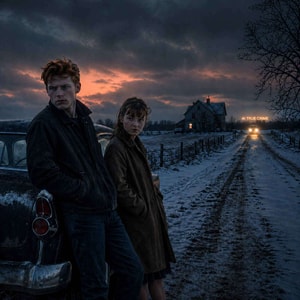
The courtroom, like the newspapers, became a theater of interpretation. Jurors were not only hearing evidence. They were looking at Caril. They were judging her face, her composure, her story, her contradictions, her youth, and her relationship with Starkweather. Every survivor in a public trial becomes a kind of performer against their will. The expected performance is impossible: grieve visibly, but not too dramatically; seem frightened, but not rehearsed; remember clearly, but not conveniently; admit confusion, but not enough to seem dishonest. Caril had to persuade adults that she had been a terrified child, while those same adults were already prepared to see her as something else.
Starkweather’s trial had a different emotional shape. He was not sympathetic in any lasting way, even when people traced the bullying, the poverty, and the humiliation that helped form him. The murders were too many, too brutal, too plainly his. He could posture, sulk, brag, contradict, or blame, but his legal fate moved toward death with grim force. He had wanted attention, and now he had the attention of the state.
Caril’s trial was more unsettled because the verdict had to answer a question that has never fully died. What does guilt mean for a child in the company of a killer? How much resistance must a victim show to be believed? How much fear is enough to explain obedience? How much manipulation can the law recognize when the relationship began before the crime, under the confusing language of teenage romance? The jury found its answer. Caril Ann Fugate was convicted and sentenced to life in prison.
She was fifteen years old by then.
That sentence remains one of the most shocking facts in the entire case. Whatever one believes about her actions, the image of a fifteen-year-old girl receiving life in prison should give pause. The state looked at Caril and did not see someone whose entire adolescence had been consumed by an older killer’s violence. It saw someone punishable for life. The law had made its decision. The public, largely, had already made its own.
Starkweather was sentenced to death. The contrast between their punishments seemed, to some, like a proper division of responsibility: he would die, she would live but lose her freedom. To others, it looked like a second destruction of a girl whose first destruction had happened in her own home. Both interpretations still exist because the case does not provide the comfort of total certainty.
The trial also fixed the case in a form that later culture would repeat. Once legal proceedings create an official story, that story becomes hard to dislodge. The killer was condemned. The girl was convicted. The phrase “Starkweather and Fugate” moved into criminal history. It would later echo through films, songs, books, and every retelling that preferred the image of doomed young criminals to the harder reality of a murdered family and a disputed child defendant.
For the victims’ families, the trials could not restore anything. Courtrooms can assign guilt, but they cannot reverse absence. Robert Colvert did not come back. Marion, Velda, and Betty Jean Bartlett did not come back. August Meyer, Robert Jensen, Carol King, Lillian Fencl, Clara Ward, C. Lauer Ward, and Merle Collison did not come back. The legal process may have been necessary, but necessity is not healing. It is only structure placed around loss.
Maybe the warning was not that teenagers were becoming monsters. Maybe it was that adults are too quick to mistake a child’s proximity to danger for adult guilt. Maybe it was that male violence often pulls girls and women into its orbit, then asks them to prove they were not complicit in their own terror. Maybe it was that America loves an outlaw story so much that it will polish even the ugliest crimes until they reflect something cinematic.
Or maybe the warning was simpler.
Charles Starkweather wanted to be seen.
The courtroom saw him. The newspapers saw him. History saw him.
Caril Fugate wanted, eventually, to be believed.
That would prove much harder.
Chapter Eight: Badlands Before Badlands
Long after the bodies were buried, the Starkweather and Fugate case kept moving.
It moved into newspapers first, then books, then songs, then film, then the larger bloodstream of American crime mythology. It became one of those stories people know even when they do not know the details. A young killer. A teenage girl. A winter road. Stolen cars. Dead families. A chase across the plains. The outline is so stark that it seems almost designed for myth, which is exactly the problem. Myth smooths. Myth beautifies. Myth finds meaning where there may have been only terror, impulse, and blood.
Terrence Malick’s Badlands is the most famous artistic echo. Released in 1973, it turned the basic shape of the Starkweather and Fugate story into something lyrical, eerie, and detached. Martin Sheen’s Kit and Sissy Spacek’s Holly are not literal copies, but the inspiration is unmistakable: the young killer with a James Dean shadow, the girl beside him, the open landscape, the dreamy narration, the murders that feel both horrifying and strangely weightless. Badlands is a great film, but it also shows the danger of aestheticizing crime. The image becomes beautiful. The dead become atmosphere.
That danger would follow the case through every retelling. Starkweather was ugly in the moral sense, but his story had visual power. A camera could love the roads. It could love the stillness of Nebraska and Wyoming. It could love the jacket, the car, the blank sky, the young faces. It could turn slaughter into mood. American culture has always struggled with this. It condemns violence, then frames it beautifully. It mourns victims, then remembers killers more vividly. It says “never again,” then makes another poster.
Bruce Springsteen’s “Nebraska” stripped the story down in a different way. The song does not retell every fact. It enters the voice of a Starkweather-like killer and lets emptiness speak. There is no glamor there, not really. The song is cold, spare, fatalistic. It understands something that more sensational versions miss: the horror is not that the killer is fascinating. The horror is that he may be hollow. People search murderers for hidden depths because depth feels like explanation. Sometimes what they find is shallowness with a gun.
Then there is Natural Born Killers, which does not adapt Starkweather and Fugate directly so much as inherit the entire American fantasy of the murder couple. By the time that film arrived, the idea had grown far beyond Nebraska: lovers on the run, violence as performance, media as amplifier, murder as celebrity. Starkweather wanted attention before the modern media machine had fully learned how to manufacture that kind of fame. Later culture would become much better at it.
That is why the case still matters. It sits at an intersection: juvenile delinquency panic, celebrity crime, gendered blame, class fear, outlaw romance, and the American habit of turning killers into symbols. Starkweather was not the first murderer to become infamous, but he arrived at a moment when the country was ready to see him as a warning about its own youth. He fit the nightmare. Red hair. Leather jacket. James Dean imitation. Working-class resentment. Dead-eyed violence. He looked like the bad future adults had been warned about.
Caril Fugate fit a different nightmare. She was the girl who did not behave the way people wanted a victim to behave. She had loved the wrong boy. She had survived when her family did not. She had remained beside him, for reasons that remain disputed and may never be fully recoverable. To the public, she became a test case in suspicion. How innocent can a girl be if she loved a killer? How victimized can she be if she did not escape? How young is young enough to be forgiven for not knowing how to survive correctly?
Those questions are not relics of the 1950s. They remain alive in the way people talk about victims today. Why didn’t she leave? Why didn’t she fight? Why did she go with him? Why did she text him? Why did she lie at first? Why was she calm? Why was she emotional? Why did she stay? The Fugate question survives because society still struggles to understand fear when fear does not look heroic.
But there is also a second reason the case endures: America loves the road. The road is supposed to mean reinvention. Escape. Youth. Distance. Possibility. Starkweather turned that national symbol inside out. His road did not lead to freedom. It led from one grave to another. He took one of America’s favorite myths and filled it with bodies.
Show Notes: Starkweather and Fugate
In this episode of AI True Crime, we look at the 1958 Starkweather and Fugate case, one of the most infamous American murder sprees of the twentieth century. Charles Starkweather, nineteen, and Caril Ann Fugate, fourteen, became the center of a national panic after eleven people were killed across Nebraska and Wyoming. The episode follows the murders, the manhunt, the trials, Starkweather’s execution, Fugate’s imprisonment, and the long debate over whether she was an accomplice, a captive, or a child the justice system failed to understand.
Sources and Further Reading
History Nebraska, Charles Raymond Starkweather Collectionhttps://history.nebraska.gov/collection_section/charles-raymond-starkweather-rg3423-am/
WyoHistory.org, “The Killing Spree that Transfixed a Nation: Charles Starkweather and Caril Fugate, 1958”https://www.wyohistory.org/encyclopedia/killing-spree-transfixed-nation-charles-starkweather-and-caril-fugate-1958
WyoHistory.org, “January 29, 1958”https://www.wyohistory.org/dates/january-29-1958
History.com, “Teenage killers murder three people”https://www.history.com/this-day-in-history/january-28/killer-couple-strikes-the-heartland
Encyclopaedia Britannica, Charles Starkweatherhttps://www.britannica.com/biography/Charles-Starkweather
Casper College, Charles Starkweather and Caril Ann Fugate Case Photographshttps://caspercollege.cvlcollections.org/collections/show/149
Wikipedia, Charles Starkweatherhttps://en.wikipedia.org/wiki/Charles_Starkweather
Wikipedia, Caril Ann Fugatehttps://en.wikipedia.org/wiki/Caril_Ann_Fugate
A\&E, “Was Caril Ann Fugate Really Charlie Starkweather’s Murderous Accomplice?”https://www.aetv.com/articles/charles-starkweather-killing-spree
The New Yorker, “The Humboldt Murders”https://www.newyorker.com/magazine/1997/01/13/the-humboldt-murders
This podcast is powered by Pinecast.