The Manson Family - Part 2
The second of four parts on Charlie and the Family
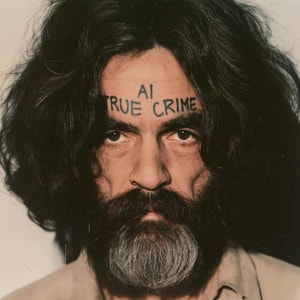
AI True Crime: Charles Manson
Part Two: The Summer of Blood
Episode Show Notes
In the summer of 1969, Charles Manson and his followers crossed the line from apocalyptic fantasies into murder. What began as a loose community of young people seeking freedom, music, and belonging had become a group capable of extraordinary violence.
In the second installment of our four-part Charles Manson series, AI True Crime examines the events that transformed the Manson Family into one of the most notorious criminal groups in American history.
We begin with a failed marijuana deal involving Charles Watson and Bernard Crowe, a confrontation that ended with Manson shooting Crowe in July 1969. Manson mistakenly believed he had killed him, and his fears of retaliation fed the group's increasingly dangerous atmosphere.
We then explore the murder of musician Gary Hinman, who was held captive and killed by Bobby Beausoleil after a confrontation involving members of the Family. His death marked an escalation in the group's violence.
The episode follows the events of August 8 and 9, 1969, when Manson sent Charles Watson, Susan Atkins, Patricia Krenwinkel, and Linda Kasabian to 10050 Cielo Drive. There, actress Sharon Tate, Jay Sebring, Abigail Folger, Wojciech Frykowski, and Steven Parent were murdered.
The following night, Manson accompanied another group into Los Angeles, where Leno and Rosemary LaBianca were selected as victims. Their murders exposed the extent to which Manson's followers had become willing to carry out violence at his direction.
Finally, we examine the investigation that initially struggled to connect the crimes, the raids on Spahn and Barker Ranches, Susan Atkins's disclosures to fellow inmates, and the evidence that led to murder indictments in December 1969.
Throughout the episode, we distinguish established facts from disputed accounts of Manson's motives, including his racist and apocalyptic interpretation of the Beatles' music.
This is the story of seven people murdered over two nights, the victims whose deaths preceded those killings, and the investigation that began exposing the Manson Family.
Sources and Further Reading
People v. Manson (1976), California Court of Appeal. The principal appellate decision covering the Tate-LaBianca murders, the prosecution's evidence, Linda Kasabian's testimony, and Manson's role in directing the killings.
https://law.justia.com/cases/california/court-of-appeal/3d/61/102.html
Justia Law
People v. Manson (1977), California Court of Appeal. The appellate decision concerning the murder of Gary Hinman, including evidence about Manson, Susan Atkins, Bruce Davis, and Bobby Beausoleil.
https://law.justia.com/cases/california/court-of-appeal/3d/71/1.html
Justia Law
Vincent Bugliosi with Curt Gentry: Helter Skelter: The True Story of the Manson Murders (1974). The influential account by the lead prosecutor, covering the investigation, the Family, the murders, and the prosecution's interpretation of Manson's motives.
Jeff Guinn: Manson: The Life and Times of Charles Manson (2013). A detailed biography that examines Manson's criminal history, the Family's development, his relationships, and the escalating violence of 1969.
Ed Sanders: The Family (1971). An early investigation of Manson's followers and their activities. It offers historical context but contains claims that should be assessed against court records and later research.
Dianne Lake with Deborah Herman: Member of the Family (2017). A former follower's account of life with Manson, providing a perspective on the group's isolation, internal relationships, and the mechanisms of control.
Next on AI True Crime
Charles Manson, Part Three: The Trial
The murders have been uncovered, the suspects identified, and Charles Manson is facing prosecution for crimes carried out largely by his followers.
In Part Three, we examine one of the most extraordinary trials in American criminal history. We follow prosecutor Vincent Bugliosi as he builds a case around conspiracy, coercion, and Manson's influence over the Family. We examine Linda Kasabian's testimony, the defendants' behavior in court, the defense's attempts to challenge the prosecution's narrative, and the verdicts that followed.
The murders had shocked America. Now the courtroom would become a spectacle of its own.
This podcast is powered by Pinecast.